Door Hangers & EDDM for Roofers: The Storm-Canvassing Playbook
After a storm, the roofer who gets on the doors first books the season. Insurance claims and adjusters move fast, so door hangers at $0.10 to $0.30 each put you on every door while the damage is fresh. Here's the storm-canvassing playbook.
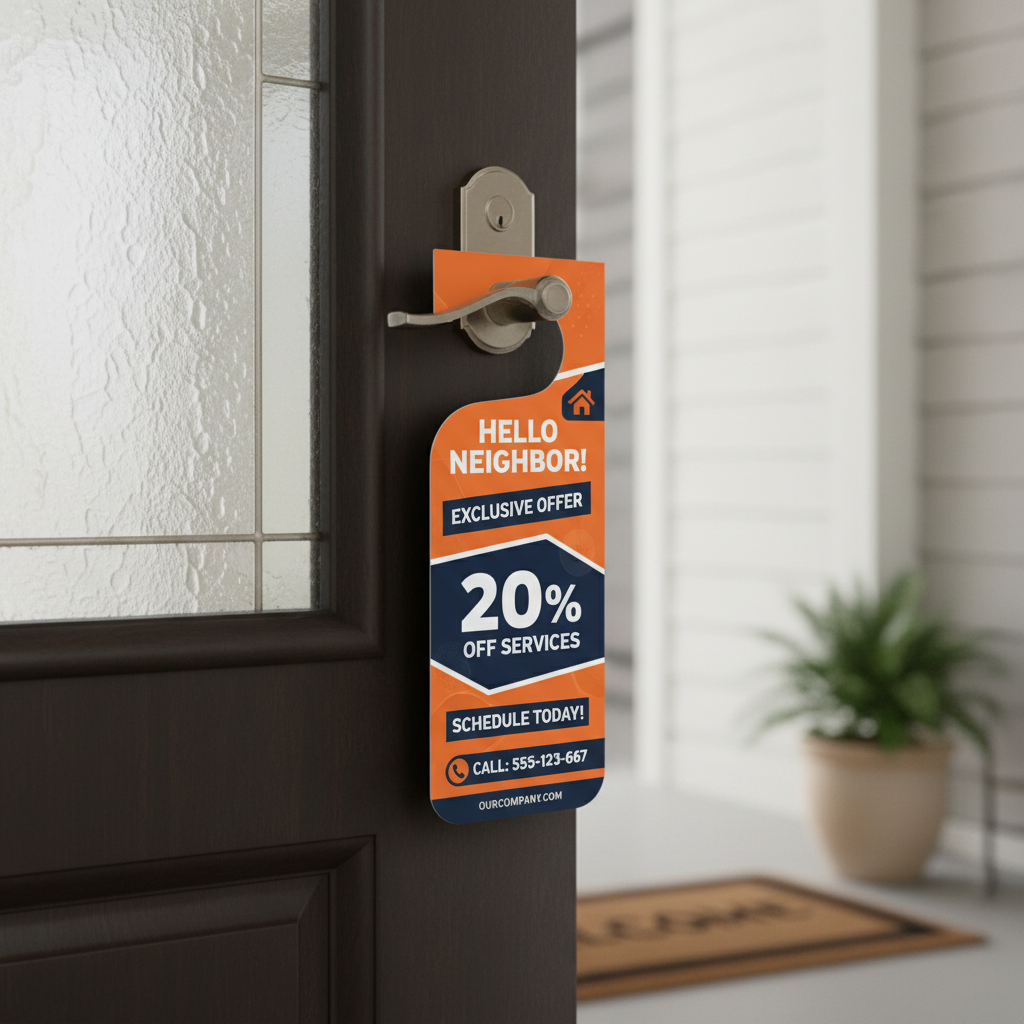
The day after hail moves through a subdivision, every roof on the street has damage at the same time, and the roofer who gets on the doors first books the season. Door hangers are the fastest way to hit every house while the damage is fresh, at $0.10 to $0.30 a hanger, so you can blanket a hail-hit block for the price of one repair. EDDM (Every Door Direct Mail) mails a full postal route for about $0.20 a home when you'd rather not knock.
Storm work runs on a clock most trades never deal with: homeowners file insurance claims, adjusters come out, and the roofers already in front of them get signed. The ones who win treat canvassing like the job it is, a fast, organized drop with one clear offer, run before the chasers finish knocking. Here's the playbook.
Why does storm canvassing work so well for roofers?
Because roof damage is neighborhood-wide and time-sensitive in a way almost no other trade's work is. When hail hits, every house on a street takes damage the same afternoon, so a hanger on all of them reaches people who need a roof this month, not a random mailbox six months out. The homes were built around the same year and took the same storm, which is why a drop on 200 homes in a fresh hail path outperforms almost anything else in roofing. The same hanger scattered across town in calm weather is wasted paper, so the rule is right neighborhood, right week, one offer.
How fast do you have to hit the doors after a storm?
Within days, not weeks, because insurance-driven roof work moves on a tight clock. Here's how the timeline runs: the homeowner files a claim, the carrier sends an adjuster out within a week or two, and whoever is already in front of that homeowner is the roofer who walks the roof with the adjuster, tape measure and photos in hand, and comes down with the contract. That first inspection decides everything, because you document the hail bruising and lifted shingles a homeowner can't see from the ground, and that documentation is what turns a knock into an approved claim and an approved claim into a signed job. Miss the window and the chasers have knocked, half the roofs on the street are under contract, and you're left bidding scraps against the companies that got there first. Watch the hail maps, then drop the affected subdivisions while the damage is the talk of the street, which means having hangers printed and stacked before the season, not ordering art the week after the storm.
Door hangers or EDDM for canvassing a storm area?
Door hangers when you're knocking and want to leave something on the no-answers, EDDM when you want reach without a crew on foot, and the best roofers run both. Door hangers go on the doorknob, so they pair with canvassing: knock, talk to the ones home, leave a hanger on the rest. EDDM mails an entire postal carrier route for about $0.20 a piece with no mailing list to buy, which is ideal for blanketing a defined storm zone fast. Knock the streets you can cover on foot, mail the ones you can't reach before the chasers do.
Try us free
Want it designed right, without the guesswork?
What should a roofing door hanger say to book a free inspection?
One offer, one phone number, "licensed and insured," and proof you're local, in that order. A free storm or hail inspection is the offer that works, because it's a low-commitment yes for a homeowner who suspects damage but isn't sure and doesn't want to file a claim blind. Lead with the offer ("Free Storm Damage Inspection") and a huge number, then add "licensed and insured" and a local line ("We're working on roofs in your area this week") so it reads as the established local roofer. A QR to your Google reviews closes the nervous ones, and cutting the wall of services and the stock roof photo keeps the offer and the number doing the work.
How do you canvass without looking like a storm chaser?
Lead with local proof, send clean crews in branded shirts, and leave a professional hanger instead of a photocopied flyer, because everything a chaser does looks rushed and out-of-town. Put your local address or "locally owned since [year]" on the piece, and park a lettered truck at the curb while you knock so a homeowner sees a real company, not a rental with a magnet. Offer to photograph the damage on the spot and leave a written estimate on your own letterhead, since a crew passing through won't take the trouble, and the homeowner remembers who did. The chaser knocks with a clipboard, out-of-state plates, and a flyer; the local roofer knocks with a brand, and homeowners are sorting for exactly that difference after a storm. Looking permanent and local is the whole edge, and it's the one thing a fly-by-night crew can't copy in a weekend.
What does it cost, and how do you make the drop book inspections?
Door hangers run $0.10 to $0.30 each, so 1,000 lands around $150 to $250, and EDDM postcards run about $0.35 to $0.55 printed plus roughly $0.20 postage a home, so a 1,000-home route is about $550 to $750 all in. Print hangers on 14pt or 16pt stock so they don't tear on the knob, and print EDDM at 6.25x9 or larger to qualify for the flat EDDM postage rate. The cost that matters is per booked inspection: one $18,000 roof off a $250 hanger run pays for a year of them, as long as you put one clear offer on the piece, track which neighborhoods you dropped, and answer the phone. Print a clean roofing door hanger or EDDM mailer built around a single offer and matched to the rest of your roofing brand, so the hanger, the truck at the curb, and the yard sign down the block all read as one local company. Your first design is free, so you can test a real piece on a neighborhood before you commit to a print run.
Keep reading
Roofing branding & design →