How to Market a Pressure Washing Business (and Stop Competing on Price)
Anybody with a machine and a truck is your competition, so you win on proof and proximity. Post the before-and-after everywhere, canvass the streets you already clean, and hold your real ad money for recurring commercial accounts. Here's the ranking and the budget.
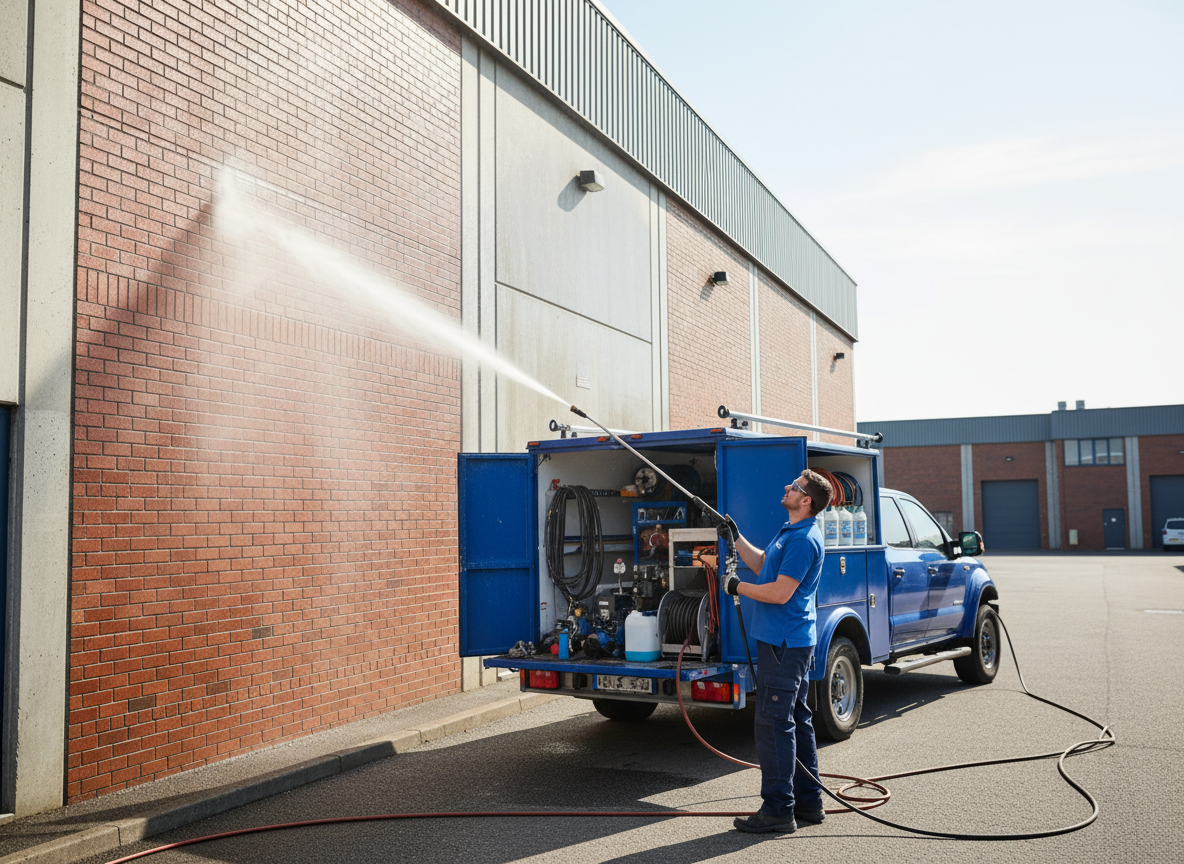
Anybody with a $400 machine from the hardware store and a trailer can call themselves a pressure washing company, and most weekends somebody new does. That is the problem you are marketing against. Here is my default for a solo operator or a two-truck crew: turn the jobs you are already doing into before-and-after reels on Facebook and Instagram, canvass the block around every clean driveway with door hangers, and keep your Google Business Profile and reviews fed. Hold your real ad budget for chasing recurring commercial accounts, not one-off residential clicks.
That order follows the math of the trade. A house wash runs $250 to $600 in most markets and a driveway $100 to $300, so you cannot pay a $60 lead fee the way a roofer chasing a $15,000 job can. Pressure washing is low-ticket, high-volume, and about as visual as work gets: the dirt-to-clean reveal sells the job on its own, and one spotless driveway is a billboard to every neighbor who walks past it.
Here's how I rank the channels, what each one runs, and where pressure washing companies burn money.
What's the best way to market a pressure washing business?
Show the before-and-after everywhere, work the neighborhoods you are already in, lock down Google Business Profile with reviews, and add paid ads for commercial work last, in that order. The transformation photo does the selling, so it goes on every channel you touch: Facebook and Instagram, the Google profile, the door hanger, the truck. Proximity does the rest, because a clean driveway on Maple Street is the cheapest ad you will ever run to the other 30 houses on the block. Paid ads come last for residential, where the ticket is too small to feed a bidding war, and first for commercial, where one storefront or HOA contract is worth real money. The backwards version, a one-truck operator dumping $800 a month into Google Ads across a 25-mile radius, pays for clicks from people who never see the driveway that would have sold them for nothing.
Why is it so hard to stand out as a pressure washing company?
Because the barrier to entry is a $300 machine and a truck, so every market is packed with operators competing on the lowest price. A homeowner cannot tell your work from the guy who started last month, and half your competition will quote a driveway $40 under what you can afford. You beat that two ways, and neither is going lower on price. First, look like a real company: a wrapped rig, a clean uniform, an on-time quote, a brand that reads as established instead of a magnet on a pickup. Second, show proof the cheap operators never capture, the before-and-after of your own jobs, so the buyer sees the result before they call. A wrapped truck or trailer parked at the curb during a job does both: it markets to the whole street and signals you are not a fly-by-night.
What's the cheapest way to get more pressure washing jobs?
Neighborhood density: sell the street you are already working before you spend a dime reaching strangers across town. Every driveway you clean is a live demo for the neighbors, and the ones with a dingy driveway two doors down notice. So the day you finish, drop a door hanger on the 20 to 40 houses around it with a photo of the work you did on their block. The economics beat any digital channel: door hangers print for $0.15 to $0.40 each on 14pt or 16pt cardstock, so blanketing a street costs less than a single day of Google clicks, and the lead lands on a route you were already driving. A one-truck operator who picked up a few accounts around Cape Coral, Florida, in 2024 grows faster canvassing the blocks he is already on than buying clicks scattered across the metro. Print a door hanger for the 20 to 40 houses around each finished job and you turn one paid driveway into a street full of quotes.
Do Facebook and Instagram reels work for a pressure washing business?
Yes, better than for almost any other trade, because the before-and-after reveal is built for video. The slow pan across a black driveway turning clean, or a roof going from streaked to bright, stops the scroll in a way a static ad never will. Shoot 15 to 30 seconds vertical on your phone on every job and post the reveal to Facebook and Instagram Reels. For $300 to $1,000 a month you can put those reels behind a paid campaign and own a few ZIP codes by radius around the neighborhoods you want. That beats tapping "boost" on a post for $20, which hands Meta your money with no offer and no targeting and books nothing. Where paid social earns its keep is seasonal pushes, a spring house-washing offer or a pre-holiday cleanup, run as real before-and-after social ads with the transformation front and center.
How do you get a pressure washing company found on Google?
Claim and fully fill your Google Business Profile, set the primary category to Pressure Washing Service, and earn a review on every job, because the map pack is where "pressure washing near me" lands. This is the highest-return free thing you own: fill every field, add a service list, and load it with real before-and-after photos instead of stock. Then make reviews a habit, ask the moment the driveway is dry and the customer is impressed, and let Jobber or Housecall Pro text the request on every job. A driveway wash is the easiest five-star you will ever earn, and reviews are the tiebreaker in the map pack.
How do you turn one-time pressure washing jobs into recurring commercial accounts?
Go after the businesses that are required to keep their concrete clean, storefronts, restaurants, gas stations, HOAs, and dumpster pads, and sell them a schedule instead of a one-off. Residential work is a treadmill: you wash a house once and often will not see that customer again for two years. Commercial flatwork comes back on a schedule and pays predictably. A restaurant sidewalk collects grease and often has a health-code reason to stay clean, a dumpster pad often carries a city degreasing requirement on a set cycle, and an HOA or property manager with a strip mall needs sidewalks, pool decks, and flatwork cleaned monthly or quarterly. One signed account is worth more than 20 one-off driveways because it repeats without re-selling. You win these on relationships, not a Facebook reel, so build a one-page proposal, walk in during business hours, and follow up. This is the revenue your paid budget and sales time should chase, because it is the only pressure washing money that compounds.
Try us free
Want it designed right, without the guesswork?
How does pressure washing marketing change through the seasons?
In most of the country the residential season runs March through September, so you book spring in January and February and chase commercial in the off months. House washing and driveways spike when people are outside and hosting, so the phone runs hottest from spring through late summer, and the crews that win it did their marketing in January and February with door hangers and a "reserve your spring wash" offer before the rush. Fall is for add-ons sold to customers you already have: gutter brightening and house washes before holiday lights go up. In a warm market like Phoenix or Tampa, residential runs close to year-round. In a cold market like Columbus or Minneapolis, you get seven or eight billable residential months, so winter is for building the photo library, shooting the reels you never had time for, and locking in the commercial flatwork that keeps the truck busy when nobody is washing a house.
How much should a pressure washing company spend on marketing?
Plan on 5 to 10 percent of revenue, which for a one-truck residential operator is $300 to $800 a month and for a multi-crew company chasing commercial and running paid ads is $1,500 to $4,000. The residential operator spends light and local: door hangers, a maintained Google Business Profile, review automation through Jobber or Housecall Pro, and a modest reel budget on Meta add up to a few hundred dollars a month, spent on print and canvassing where a proximity business grows. The company scaling into commercial and multiple trucks spends more because it is buying reach: paid social, Google Ads on terms like "commercial pressure washing," where clicks run $4 to $12, and the sales materials to land accounts. The trade-off is plain: spend residential money like a commercial shop and you overpay for clicks on $200 driveways, and starve the commercial push and you never land the accounts that would smooth out your winter.
Get the before-and-after content flowing, work the streets you are already on, keep the profile and reviews fed, and point your real ad money at the commercial accounts that repeat. Keep every piece, the reel, the door hanger, the wrap, the profile photo, matched as one pressure washing brand so the driveway a neighbor saw this week reads as the same company on the door hanger next week. A flat-rate design plan keeps all of it consistent for one monthly cost, and your first design is free, so you can see it before you spend on print or ads.
Keep reading
Pressure Washing branding & design →