Do Yard Signs Still Work for Contractors?
Yes. At $8 to $15 a sign, a yard sign turns a finished job into leads from the neighbors already watching the work. Where to place them, what to put on them, and how to track it.
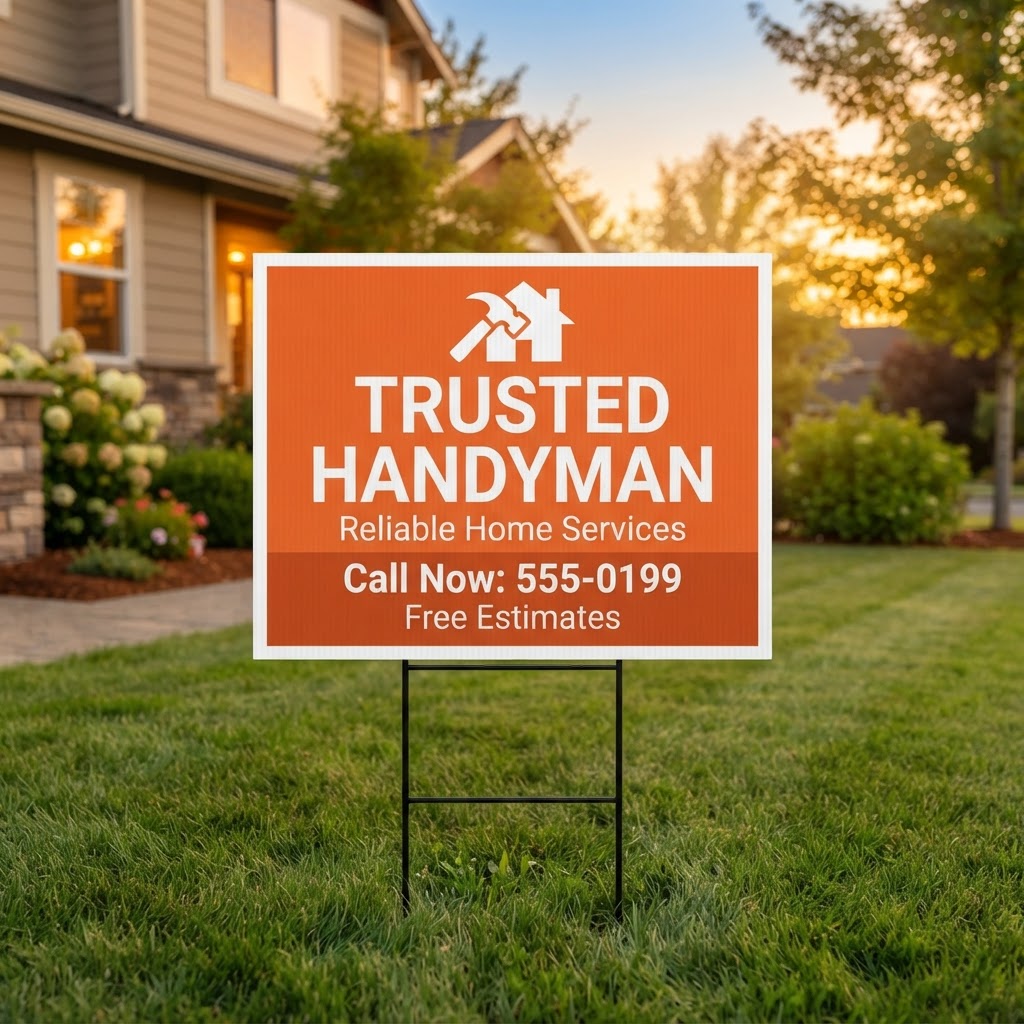
Key facts
- Yard signs cost $8 to $15 each, one of the cheapest lead sources in the trades.
- A good sign in a busy neighborhood pulls a handful of calls over the 2 weeks it stands.
- Standard spec: 18x24 or 24x36 inches, double-sided on 4mm coroplast, on a galvanized H-stake.
- Put the phone number as the biggest element after the logo, readable from the street.
Yes, yard signs still work, and per dollar they're one of the best lead sources in the trades. At $8 to $15 a sign, a yard sign in front of a finished job turns the neighbors who watched you work into calls. No algorithm, no monthly fee, no bid war.
They stopped working for the contractors who make them ugly, cram them with text, or never put them out. Done right, a yard sign is close to free advertising in the exact neighborhoods you want more work.
Do yard signs still work for contractors?
Yes, especially for home-service trades that do visible work in neighborhoods. A roof, a fence, a new AC unit, a paint job: the neighbors notice, and a sign in the yard tells them who did it and how to call. It's proof plus a phone number at the moment they're thinking "our house needs that too."
The trades where signs shine are the ones where the work shows and neighbors compare. The signs earn their keep for weeks after you leave, as long as the homeowner lets it stand and the sign reads from the street.
Try us free
Want it designed right, without the guesswork?
How many leads does a yard sign get?
A good sign in a busy neighborhood pulls a handful of calls over the couple of weeks it stands, and it cost you $10. The exact count moves with traffic, how long it's up, and how visible the yard is, but the math is the point: even one job off a $10 sign is a return nothing else touches.
Signs compound when you run them on every job. Ten jobs a month with signs is 10 signs working across 10 neighborhoods, and recognition builds as people see your name on three lawns in the same zip code. That repetition is the win, not any single sign.
Where should you place yard signs?
In the yard of every job the homeowner allows, plus a few high-traffic corners with permission. The finished job is the best spot, because the sign sits next to proof of your work. Ask the homeowner when you start, not when you leave, and most say yes.
Beyond job sites, a busy intersection or a friendly business's lawn adds reach, as long as you have permission and it's legal locally. Skip illegal right-of-way spots, because a code officer pulling your signs is money in the trash. Put them where they're seen and where they'll stand.
What should go on a yard sign?
Your company name, one service, a huge phone number, and a QR code, and nothing else. A sign has about three seconds from a passing car, so it works like a billboard, not a brochure.
Set the phone number as the biggest element after the logo, readable from the street. State one thing you do ("Roofing," "AC Repair") so a driver knows in a glance. Add a QR code to your Google reviews or booking page for the ones on foot. Leave off the paragraph of services, the license fine print, and the clip art. White space is what makes the number readable.
What size and material hold up outdoors?
18x24 or 24x36 inches, printed double-sided on 4mm coroplast, on a galvanized H-stake. That's the standard for a reason: big enough to read from the road, cheap enough to run on every job, and tough enough to survive weather.
Go double-sided so the sign reads from both directions of traffic. Coroplast at 4mm handles wind and rain through the season, and the H-stake pushes into a lawn in seconds and holds. For a permanent spot, step up to aluminum, but for job-site signs you reuse and replace, coroplast is the call.
How do you track whether a sign works?
Ask every caller how they found you, and put a simple code or offer on the sign. Tracking outdoor signs is harder than tracking ads, so use two cheap methods. Train whoever answers the phone to ask "how'd you hear about us?" and tally the "saw your sign" answers.
For a tighter read, put an offer or a QR code that only appears on the signs, so a scan or a mention ties straight back. You won't get ad-level precision, and you don't need it. A handful of tracked calls a month off $10 signs tells you plenty.
What kills a yard sign's results?
Too much text, a small phone number, an ugly layout, and leaving signs out too long. Each one quietly wastes the spend. A sign crammed with nine services and 6-point license text reads as noise from a moving car.
The other killers: a phone number you can't read at 30 feet, a design that looks homemade, and a faded sign left standing for months after the job so it says "old news" instead of "fresh work." Print a clean, bold yard sign design built to read from the curb, run one on every job, and pull it when the next job starts down the street. Your first design is free, so you can see it big before you print a stack.
Frequently asked questions
- Do yard signs still work for contractors?
- Yes, especially for trades that do visible work in neighborhoods. At $8 to $15 a sign, a yard sign in front of a finished roof, fence, or AC job turns the neighbors who watched you work into calls, and it keeps working for the weeks it stands.
- How many leads does a yard sign get?
- A good sign in a busy neighborhood pulls a handful of calls over the couple of weeks it stands, for about $10. The win is running one on every job, so ten jobs a month means ten signs building recognition across ten neighborhoods.
- What should go on a yard sign?
- Your company name, one service, a huge phone number, and a QR code, nothing else. A sign gets about three seconds from a passing car, so it works like a billboard: the number is the biggest element after the logo, and white space is what makes it readable.
- What size and material should a yard sign be?
- 18x24 or 24x36 inches, printed double-sided on 4mm coroplast, on a galvanized H-stake. That's big enough to read from the road, cheap enough to run on every job, and tough enough to survive a season of weather.
Keep reading
Contractor branding & design →